
The Canon EOS R6V – Canon’s answer to the Nikon ZR
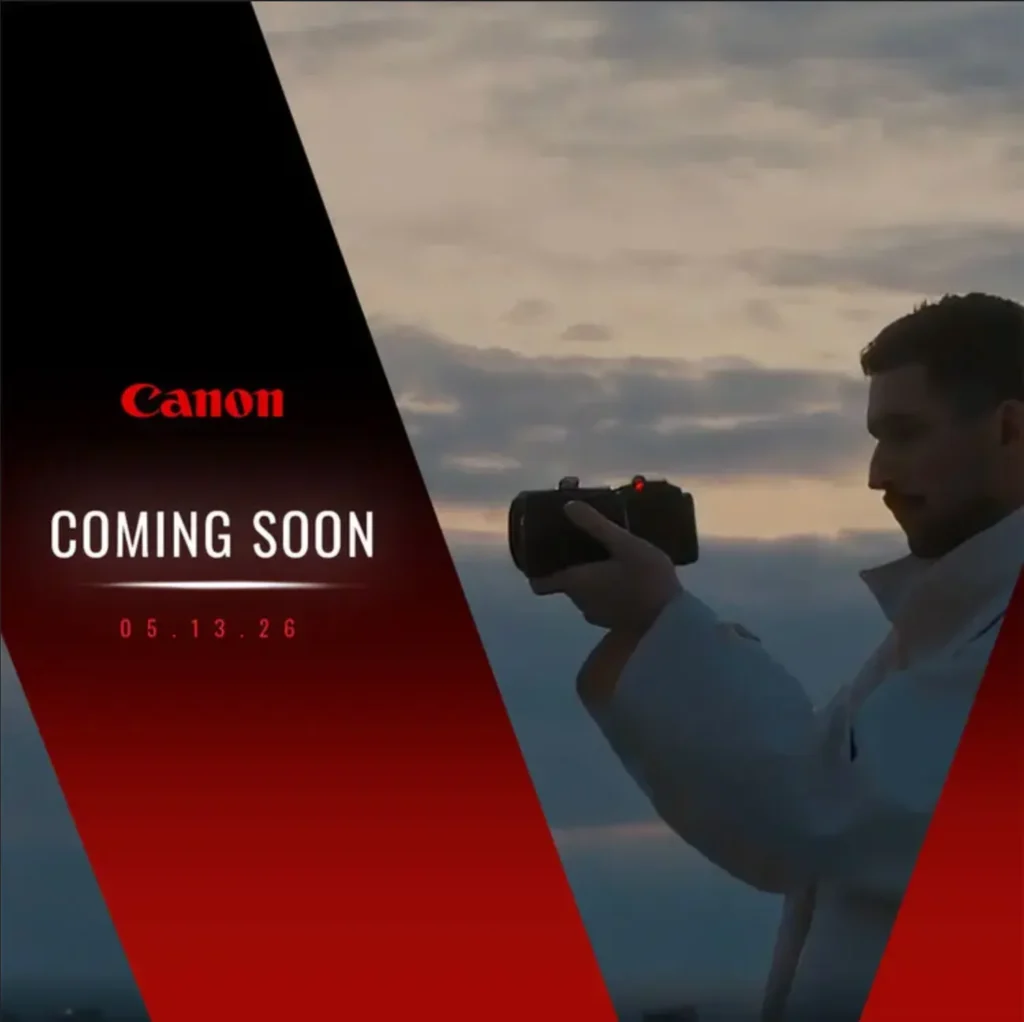
After months of rumors, some more accurate than others, Canon is set to officially unveil the EOS R6 V on May 13, 2026 at 9:00 AM EDT / 14:00 BST / 22:00 JST) alongside the RF 20-50mm f/4L IS USM PZ power zoom lens. Canon teased a preview of the camera in a short clip on Instagram.
On the same day Sony is launching it’s highly anticipated Sony A7R VI which they also teased and will be officially released just 30 minutes after the Canon announcement at 9:30 AM EDT / 14:30 BST / 22:30 JST.

Shipping of the new R6V is expected to begin in June 2026 and the price is rumored to be around $2,499 body only (roughly $300–$400 below the R6 Mark III) and around $3,499 – $3,599 with the kit RF 20-50mm f/4L IS USM PZ lens (the lens alone will be price at $1,399).
The Canon EOS R6V aims to deliver high-end video capabilities in a more affordable, hybrid-friendly body – a go between the low end R50V and the high end C50.
Key Rumored Specifications
Here is a list of the largely confirmed specs of the new Canon R6V, divided by category:
Sensor and Image Quality
- 32.3MP Full-Frame CMOS sensor (shared with the EOS R6 Mark III and EOS C50).
- Effective resolution supports a maximum stills resolution of approximately 6960 × 4640.
- Native ISO 100–64,000 (expandable to 50–102,400).
- Electronic shutter with speeds up to 1/16,000 sec.
Video Capabilities
- 7K 60p RAW internal recording (12-bit)
- Open Gate 7K 30p RAW
- Support for Canon Log 2 and Canon Log 3 gamma curves.
- 10-bit ProRes RAW output via HDMI (up to ~6.9K).
- 4:2:2 recording options.
- Internal active cooling
It will have similar video specs to its big brother the C50, with the very welcome C-Log2 profile, giving use more freedom to color correct in post (+higher dynamic range). The implementation of active cooling is a nice addition, as Canon has been known to overheat in higher recording formats and longer video sessions.

Autofocus and Stabilization
- Dual Pixel CMOS AF II with up to 1,053 focus points.
- Expected to inherit the excellent subject tracking (people, animals, vehicles) from recent Canon bodies.
- In-Body Image Stabilization (IBIS) rated up to 7.5 stops, paired with lens IS
Autofocus is one of Canons strong suits and it inherits the Dual Pixel CMOS AF II that se already saw on the R6II and C50 – it might still be less accurate than the R5II, which is in a higher tier category.
The inclusion of IBIS in this model is a welcome surprise, as one of the arguments against the C50 is the lack of IBIS: Canon argued that for (semi) professional videography, IBIS can have significant drawbacks, which is why they didn’t include it in the C50. This is of course true, but for run and gun videography a good image stabilization system is so very welcome and can significantly improve the quality of the video.
Body and Ergonomics
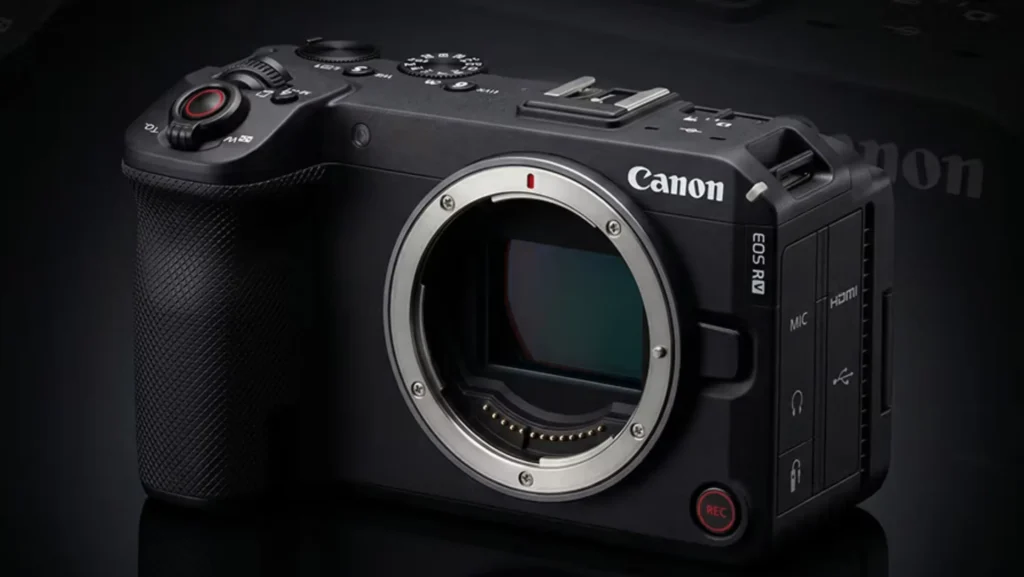
- Box style (FX3) body with no built-in EVF with 3 inch fully articulating screen
- R1-style cross-hatch grip for better handling.
- Dual card slots: CFexpress Type B + UHS-II SD.
- LP-E6P battery support.
- Compact dimensions (approx. 14.17 × 8.33 × 7.98 cm in one leak) and weight just under 600 grams
- Full-size HDMI, microphone, headphone, USB-C (with power delivery), and remote ports.
The lack of an EVF and emphasis on cooling and open-gate recording position this as a “baby C50” or a more affordable cinema hybrid rather than a traditional stills camera.
Photography Performance
While video is the focus, stills capabilities should mirror or closely match the R6 Mark III: solid burst rates, excellent AF, and high image quality from the 32MP sensor. The lack of an EVF can hinder the photographic experience and its 3-inch screen will not help in framing the shot in a manner comparable to the R6III.
Conclusions (for now)
The EOS R6 V is positioned somewhere in the middle between the entry level APSC R50V and the higher-end, much pricier C50 – this makes sense in the Canon line-up. But it is niched in the same category as the Nikon ZR, which has been very successful for Nikon, swaying many videographers from their trusted Sony FX3’s.
The Canon R6V does have some features that are missing in the Nikon ZR, such as open gate, active cooling (not that the ZR needs it) and a higher resolution sensor, but the Nikon ZR has Red Raw, a 4-inch very bright screen and 32 internal bit float audio recording, not to mention the possibility of adapting Sony (and other) lenses. Nikon has also promised the much needed firmware updates, which should improve/add some of the features that the Nikon community has been asking for, while Canon is not really known for its firmware updates.
The success of this camera will mainly hinge on how it actually preforms in the real world and might be a good alternative to the ZR, particularly to videographers who are already in the Canon system.